
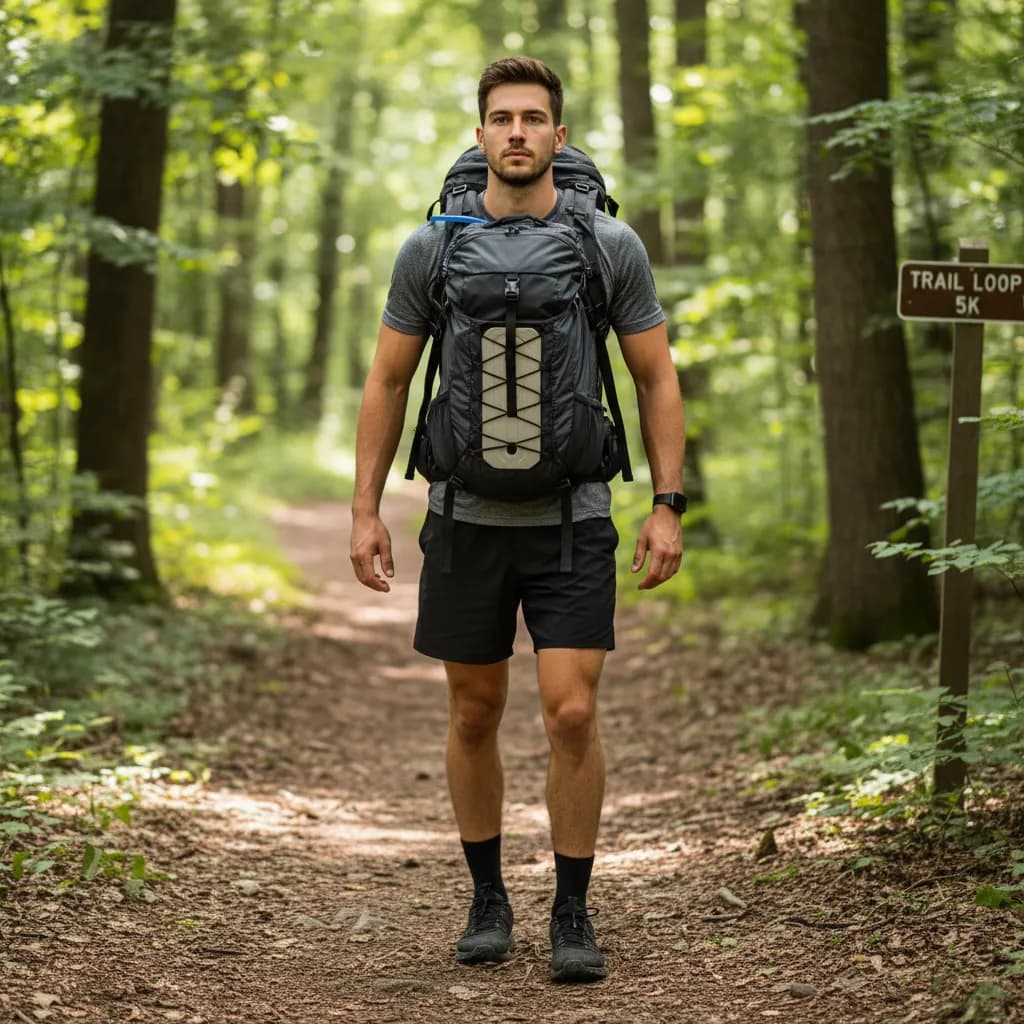
You might have stumbled on rucking in a military forum, a friend’s Instagram, or while looking for gentler cardio. Picture this: you toss a 30-lb pack on, head out, and notice your heart rate climb, your posture firm, and your legs quietly doing more work than a regular walk. That’s rucking — deceptively simple, oddly satisfying, and shockingly effective. In this post you’ll learn what rucking is, why it fits your body’s evolution, and how to start without turning every walk into a military march.
1) What Is Rucking and Why It Matters
What is Rucking?
What is Rucking? It’s simple: you walk while carrying weight in a backpack on purpose. That’s it. You’re not just hiking with snacks—you’re doing a load carriage workout, where the added load is the training tool.
The word “rucking” grew out of military circles. For centuries, soldiers have built real-world fitness by moving under load—because the job requires it. In the U.S. military and many others around the world, rucking has been a standard practice for a very long time: put weight on your back, cover distance, get stronger and tougher.
Why your body handles load carriage so well
Rucking matters because it matches what your body is built to do. Humans are unusually good at endurance. You can cover long distances on foot, even day after day. In fact, people can walk tens of miles in a day—some examples go as high as 75 miles in a single day under the right conditions.
Just as important, humans are also built to carry. Research and field experience suggest you can carry up to about 33% of your body weight efficiently, especially when the load is packed well and you build up gradually. That’s a big reason the Rucking Benefits feel so practical: you’re training strength and endurance at the same time, using a movement pattern your body recognizes.
An evolutionary picture that makes rucking click
Imagine you’re hunting. Once you get the animal, the hard part isn’t over—you still have to pack the meat back to camp. That “carry it home” problem shows up again and again in human history, and it helps explain why rucking feels natural when you do it consistently.
This idea lines up with evolutionary research on human endurance, including work discussed by Harvard researcher Daniel Lieberman on the adaptations that make humans strong distance movers. Rucking adds the missing piece: not just moving far, but moving far with a load.
2) The Physical Benefits: Burn Calories, Build Strength, Save Joints
Burn Calories and Boost Fat Burning (Without Needing to Run)
Rucking is simple: you walk with weight. That one change can help you Burn Calories fast. In studies, rucking often burns 30–50% more calories than normal walking because your body has to move extra load over distance. You also get a strong Fat Burning effect without the pounding that comes with running.
There’s a useful real-world example from a small study on backcountry hunters who carried heavy loads deep into the mountains for about 10 days. They reportedly lost around 14% body fat while keeping the same amount of muscle (some even gained a little). That’s a big deal, because many “pure cardio” plans can lead to muscle loss when you diet or train hard.
Build Strength While You Train Your Heart
Rucking isn’t just cardio. It’s also resistance training that helps you Build Strength through your:
- Legs and glutes (each step is loaded)
- Core (bracing to stay tall and stable)
- Back and shoulders (supporting the pack)
- Stabilizers in hips, ankles, and feet
It can push your heart rate higher than you expect. One ruck session after a two-week break reportedly hit about 165 bpm, while typical rucks often sit in the 130s–140s. That means you can get a real cardiovascular stimulus while still moving at a walking pace.
Low Impact for Joint Health (Compared to Running)
If you care about Joint Health, rucking has a major advantage: it’s Low Impact compared to running. Running can create about 8× your bodyweight in force through the knees with every step. Walking is closer to 3× your bodyweight. Rucking adds load, but you’re still walking—not running—so the impact stays much lower than typical run training.
This matters because military research often links high-volume running with common overuse injuries. Rucking can be a smarter way to build fitness, support bone density, and train consistently with less wear and tear.
3) Bone Density, Deceleration Skills, and Longevity
Bone Density: loaded walking that may beat “lifting only”
Rucking is simple: you walk with a load. That one change can make it a powerful tool for Bone Density, because your bones respond to repeated, weight-bearing impact and tension. Research insights on loaded walking suggest it stimulates bone cell growth in ways that may exceed weight training alone. In the source material, studies on women are highlighted where rucking improved bone density better than weightlifting alone—a big deal if you’re thinking about long-term strength and fracture risk.
This matters even more as you age, and it’s especially relevant for women, who face a higher risk of bone loss over time. Rucking gives you a steady, repeatable way to load your skeleton without needing complex gym programming.
Eccentric Strength: downhill rucking teaches you to decelerate
Uphills challenge your heart and lungs, but downhills teach a different skill: control. When you walk downhill with weight, your quads and hips work in Eccentric Strength—they lengthen while producing force. That’s the “braking system” you use in real life.
Can you walk downstairs without collapsing? Can you step off a curb and not get hurt? If you don’t know how to decelerate, you’re hosed.
Downhill rucking trains that deceleration on purpose. It’s hard to get the same skill from normal cardio, and you don’t easily practice it in the gym unless you train eccentrics directly.
Joint Friendly loading, posture improvement, and real-life resilience
Done with sensible weight and good form, rucking can be Joint Friendly because it’s still walking—low skill, controlled speed, and easy to scale. The load also encourages Posture Improvement: you naturally practice staying tall, stacked, and stable under weight.
- Bone Density support through consistent, repeatable loading
- Eccentric Strength from descents for stairs, balance, and fall resistance
- Save Joints approach: adjust pack weight, terrain, and pace as needed
There’s also a practical longevity angle: hunter-gatherer women historically carried loads as part of daily life and stayed capable for longer. Rucking mimics that pattern—regular, functional loading that supports strong hips, legs, and bones.
4) Practical Starter Guide: Gear, Progression, and Common Pitfalls
Ruck Equipment: keep it simple, keep it sturdy
You don’t need much to Get Started Rucking. The main requirement is a sturdy backpack that won’t sag, bounce, or tear when loaded. Many people in the rucking community point to Goruck as a well-known option—built specifically for rucking and popularized for civilians by founder Jason McCarthy and the “tribe” around it.
- Backpack: durable straps, strong stitching, snug fit high on your back
- Weight: a plate, sandbag, or tightly packed items (avoid loose loads)
- Footwear: comfortable walking shoes or boots with good grip
Load: start conservative (10–30% bodyweight)
This Rucking Guide rule of thumb: begin around 10–30% of your bodyweight and build gradually. If you’re new, start closer to 10% and focus on comfort and form. A reasonably fit person may eventually handle very heavy carries—some can even carry bodyweight briefly—but that’s an advanced target, not a starting point.
Progression: build your Rucking Workout with pace, hills, and Zone 2 Aerobics
First, prioritize a steady walking pace and consistent weekly sessions. Then add stress in small steps.
- Weeks 1–2: 20–40 minutes, flat terrain, light load
- Weeks 3–4: add 5–10 minutes or a small weight increase
- After that: add hills to speed cardiovascular gains
Use your heart rate to guide effort. Aim for Zone 2 Aerobics (about 60–70% max HR) for most sessions. If you’re deconditioned, short spikes (even up to ~165 bpm) can happen on hills—bring the pace down and recover, then continue.
Downhill technique: the hidden skill
Downhills load your legs with eccentric work. Keep steps short, stay tall, and control your speed. This protects knees and builds real-world strength.
Common pitfalls to avoid
- Jumping to heavy loads: soreness and strain rise fast
- Loose weight: shifting loads cause rubbing and back fatigue
- Ignoring acclimation: even a two-week break can make the same ruck feel much harder—restart lighter
- Sloppy posture: don’t lean forward; tighten straps and keep ribs stacked over hips
5) Wild Cards: Small Anecdotes, Thought Experiments, and Why You’ll Keep Rucking
A family moment that makes Resistance Training click
You don’t need a lab coat to understand why rucking works—you just need a hill and a backpack. One of the funniest proofs is how teachable it is. Picture your 13-year-old walking with you, hitting an uphill, and noticing what’s happening: your heart and lungs feel “obliterated” on the climb, but your legs complain in a different way on the way down. Then she casually explains the difference between concentric strength (pushing up the hill) and eccentric strength (controlling the descent). That’s Rucking Benefits in real life: it’s simple enough to learn as you go, and real enough that even kids can feel the mechanics and name them.
A thought experiment: the 10-day pack-in reality check
Now zoom out. Imagine you’re part of a backcountry pack-in hunt for 10 days. You’re carrying loads deep into the mountains, day after day. In a small study of hunters doing exactly that, they reportedly lost about 14% body fat over the trip. You don’t need to copy the extreme version to get the point. Rucking is functional fitness: it trains you for the kind of tired that comes from doing something useful, not just “getting a workout.” That’s why it sticks—because it feels like preparation for life.
Why RuckLife becomes a habit
Rucking is like walking in hiking boots, but with a purpose. It’s not exercise theater. It’s work that doubles as training. You can teach it, scale it, and share it—add a little weight, choose a route with hills, and you’ve built a repeatable form of Resistance Training that fits into normal days. And once you notice how it changes your posture, your breathing, and your confidence on stairs and trails, you’ll keep coming back. That’s the quiet magic of RuckLife: it’s accessible, it’s practical, and it feels earned.